

How to save tomato seeds!
Why save ’em?
Have you ever wondered how to save tomato seeds? Saving your seeds is an excellent way to become more self-sufficient in growing and producing your own food! Seed saving also saves you money! You won’t have to go to the store or order any online when it comes time to plant. Saving you time, gas, shipping and handling, and purchasing the product.
Take control of the food you put into your body by saving your seeds! You can start today!
Depending on the variety of tomatoes you are growing, just one plant can yield 5 (five) - 10 (ten) pounds, and even more if you utilize a trellis.
Imagine saving just one of the fruits for its seeds. That tomato could provide you with a minimum of 20 (twenty) seeds (depending on the variety). Tomatoes generally have a 75% (seventy-five) germination rate, so out of the 20 (twenty) seeds you save,15 (fifteen) of those seeds would be viable and sprout. If 15 (fifteen) tomato plants thrive and would produce even a minimum of 5 (five) pounds per plant, that would give you 75 (seventy-five) POUNDS of tomatoes to make sauces with, can, preserve, freeze dry, dehydrate. What could you do with 75 (seventy-five) pounds of tomatoes? The possibilities are truly endless; time to get creative!

Method for How to save tomato seeds:
When your tomato plants sprout and grow, they will produce a little branch off the central stalk with blossoms that will bud. Once pollinated, the tomato plant goes into the production phase. A small fruit will begin to grow, and the bloom will fall off.
Suppose you want to preserve a specific variety of tomato and prevent cross-pollination with another fruit; you will want to get some fine mesh bags with a drawstring to place around the blossom’s branch once the tomato plant beings to bud. Place the mesh bag on the stalk before the fruit blossoms open.
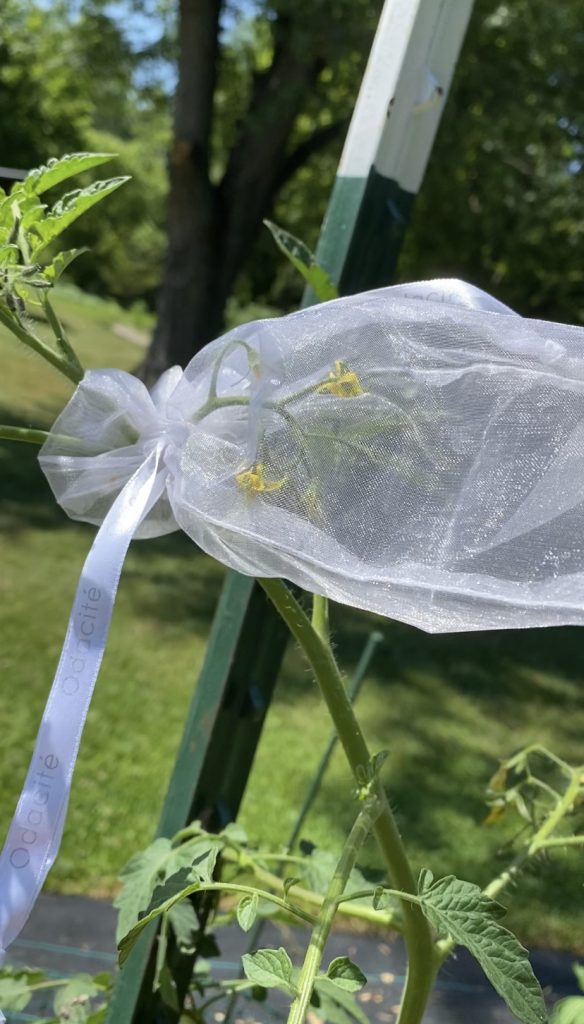
You will want to watch daily to observe when the flowers open. You can assist in the pollination by gently moving the mesh bag around with your index finger (kind of like gently scratching behind your pet’s ear when you pet them). Take the bag off the blossoms a few days after they have opened. If you leave the bag on and it gets wet, it can cause your blooms to die, and they will fall off the stalk and not produce anything for you.
You will need the following:
- a small jar
- water
- a breathable covering (i.e., coffee filter, cheesecloth, flour sack)
- a rubber band
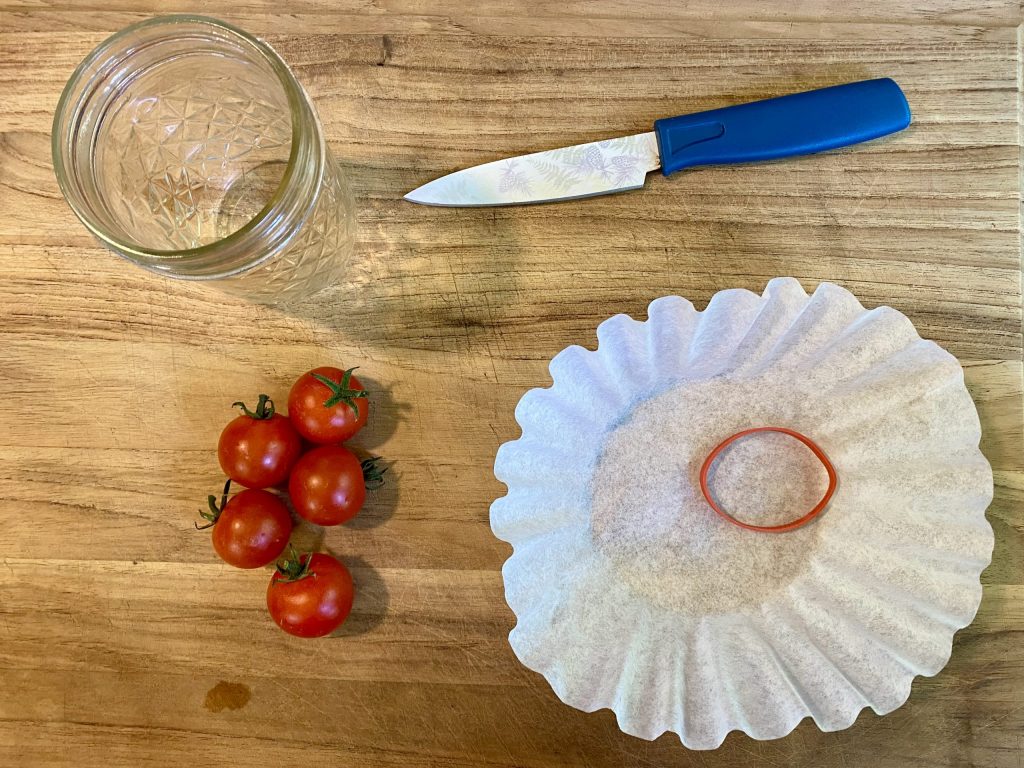
Fermentation:
If you don’t mind having a cross-pollinated variety of tomatoes, just take your ripe fruit, slice down the middle CAREFULLY, and use your index finger to wipe out the seeds. I use a small bowl under my tomatoes when doing this.
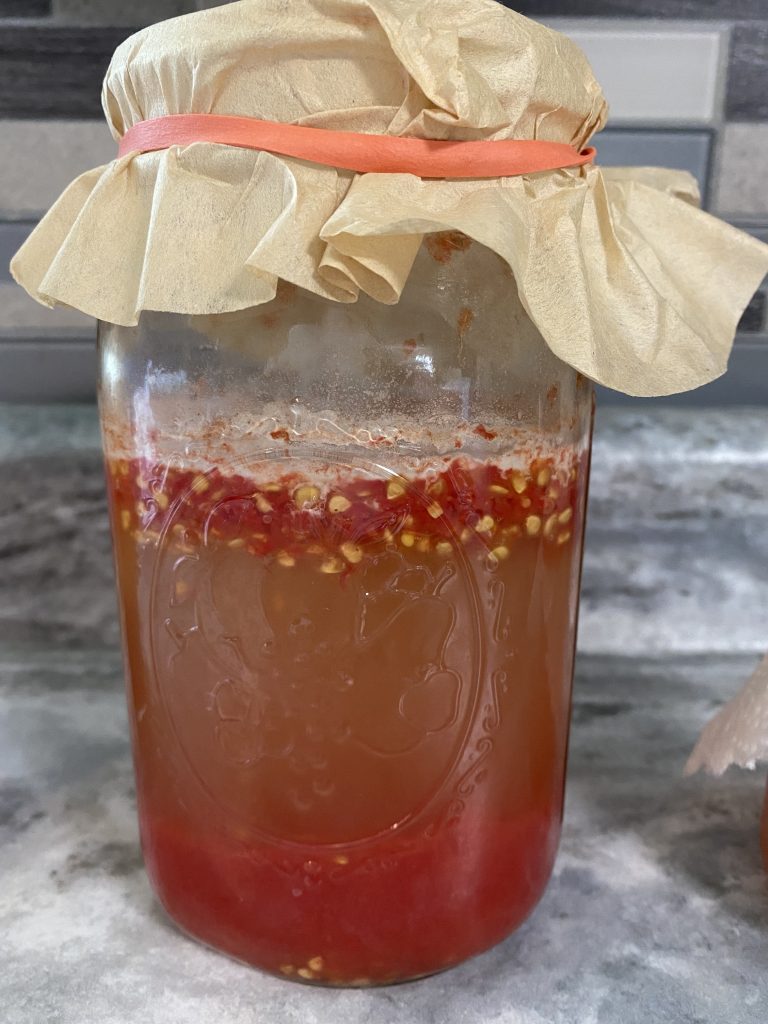
Take the tomato seeds you plan to save and add them to your jar. Next, you will fill the jar half to three-fourths full of water. Take your breathable covering and place it over the top. I use a coffee filter that I have written the date and fruit variety on the top. If you use cloth, write down the date and variety on a slip of paper, tape it to the jar, or set it underneath. There is nothing worse than saving more than one variety of tomato seed at a time and getting them confused. Set the jar in a cool dark place for a few days. Every day, check your seeds and swish them around in the water.
Tomato seeds are encased in a gel sac. This is so that when the fruit is eaten, the seed will not become digested but passed through the gastrointestinal tract allowing the fruit to live on and create more plants. Fermenting the seeds for a few days acts as the stomach acid that digests the casing. This will allow the gel sac around your seed to fall off when you rinse your seeds before drying.
Time to grab your strainer!
Drying:
Once all the seeds have risen to the top of the liquid, you dump your fermented seed and water mixture into a fine strainer or a colander lined with cheesecloth. Rinse your seeds with cold water, using your fingers to gently rub them on the sieve. The gel sac will disintegrate and be washed down the sink. I rinse my seeds and swish them for about 5 (five) minutes to ensure that I get everything off.
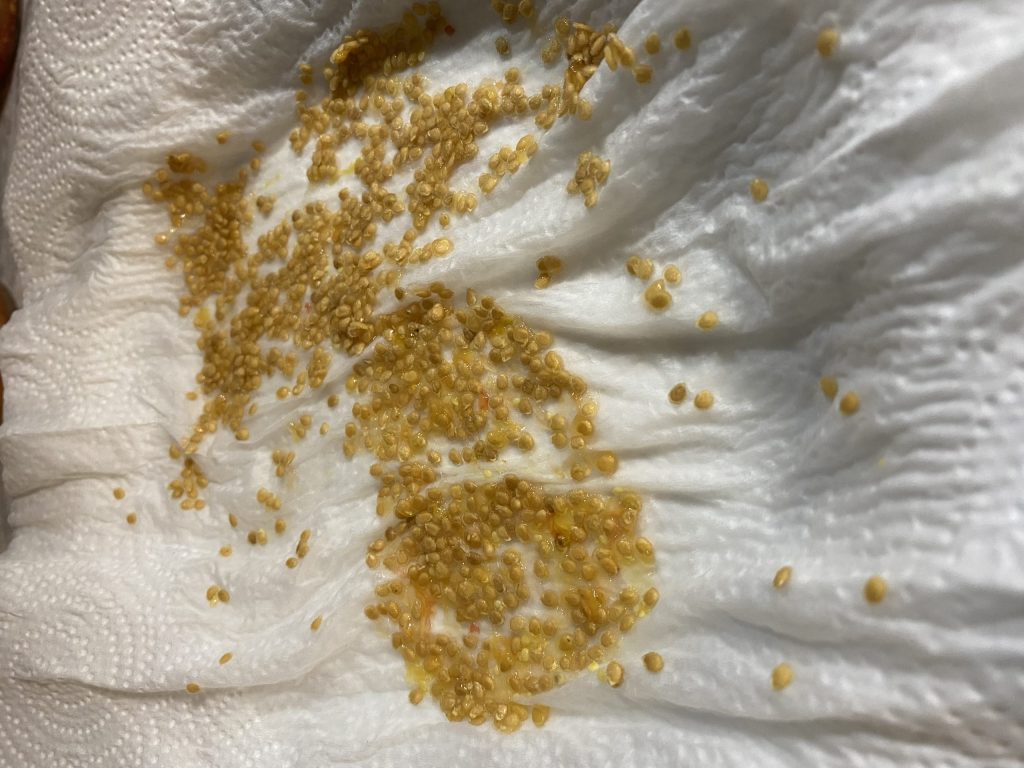
Next, you will need a paper towel or a cloth towel. Place the towel over a plate or bowl. Gently spread the tomato seeds you have fermented and rinsed over the towel, ensuring that there are not any big clumps of seeds. Set your seeds up and out of reach of children and pets that could knock them over. I also place my seeds in a room with a ceiling fan. Do not set the fan on such a high mode that it will blow them all over once they are dry. If they are taking longer to dry, you will want to leave your seeds out for 24 (twenty-four) to 48 (forty-eight) hours…or more.
Saving:
Once the tomato seeds you are saving have dried, you will need to place them in an air-tight container, plastic bag, or paper envelope. Some people put their seeds in paper envelopes if they don’t think they have dried all the way. I found this will also cause moisture to get to your seeds if you don’t place the envelope in a container with an air-tight seal (such as a plastic tote with a rubber gasket). I wait until my seeds have completely dried and place them in a plastic bag or glass jar. If you place seeds that still have moisture in a plastic bag or sealed jar, there is a high chance of mold growth that will terminate the seed’s viability.
Store your saved seeds in a cool dark place. Scientists have sprouted seeds they’ve found deep in caves thousands of years old. Storing in a cool, dry place is the way to go! Label them with the seed type, variety, and date. Seeds stored properly last MUCH longer than just one year. Though the viability does decrease somewhat as the years pass, if you save just one fruit’s seeds every year, you will have more than enough to sustain yourself!
Saving seeds is a beautiful way to grow closer to nature and connect with the process of life. If you save seeds of one variety, you can trade them with another who has saved another type of fruit or vegetable. You could even breed your own variety of plants!
That's a beginners guide on how to save tomato seeds!
Have you ever tried saving seeds from your garden? I would love to hear all about your seed saving ventures!
